Tag: reviews3

  • Peter Maxwell Davies: The Scotsman

    Edinburgh Youth Orchestra **** St Mary’s Metropolitan Cathedral

    By SUSAN NICKALLS

    THE last of the Edinburgh Youth Orchestra’s Spring concerts drew a capacity audience to hear a varied and ambitious programme which highlighted the considerable abilities of these young musicians.

    Close to 100 players delivered a powerful and well-paced performance of Stravinsky’s The Firebird: Ballet Suite. At full-strength the EYO are a force to be reckoned with and it was only in some of the more exposed areas that the occasional weakness was to be found.

    In Khachaturian’s Adagio from Spartacus, the laid-back rhythms often came adrift although the string sound was solid throughout. Prokofiev’s musical tale for children, Peter and the Wolf, is popular with audiences of all ages, and the EYO, with narrator Julian Lloyd Webber, gave an animated and often humorous performance. The soloists, who all played superbly, wore hats to indicate their particular character, with conductor En Sao entering into the spirit of things by wearing a wolf hat.

    Lloyd Webber then took up his cello to play David Horne’s rather lightweight arrangement of Peter Maxwell Davies’s piano interlude Farewell to Stromness for cello and string orchestra. The lilting melody suited the mellifluous tones of Lloyd Webber’s cello, which were spun like gold in the bright acoustics, but this was often undermined by an accompaniment which tended to flatten rather than lift the tune.

  • Vivaldi Concerto for two cellos

    Birmingham Post on May 31 2018

    Orchestra of the Swan at the Royal Birmingham Conservatoire

    May 28, 2018
    Reviewer: Christopher Morley

    May 28, 2018
    Reviewer: Christopher Morley

    It was a wonderful house-warming as Orchestra of the Swan moved into its new Birmingham residence on Bank Holiday afternoon, and there was a packed audience to savour the occasion.

    Julian Lloyd Webber, RBC Principal, was the genial host, his batonless conducting, often with a cellist’s sweep of phrasing and articulation as the music unfolded, drawing performances of utter enjoyment from the OOTS players, whose generous enthusiasm was unbounded.

    There were three cellists in this relationship, Lloyd Webber collaborating with the remarkable Jian Wang (and conducting here scoreless in a work he himself has played countless times) in Haydn’s lovely C Major Cello Concerto. Wang’s initial entry was stunning and imposing, followed by flowing facility of passage-work conveyed through lissomly athletic bowing. The finale proved a spectacular technical display from both soloist and orchestra (such fizzing violin unisons).

    Jiaxin Lloyd Webber partnered Jian Wang in Vivaldi’s G minor Double Cello Concerto, the familiar Vivaldi template enlivened by the empathetic interplay and dynamic energy between the soloists. The Largo, just soloists and orchestral cellos, was particularly affecting, and the quarrelsome finale was theatrically effective, part of it the basis for a Mad Hatter’s Tea Party of an encore, both Lloyd Webbers and Jian Wang all swopping roles.

    Framing these concerti were two great Elgar works for string orchestra, both sounding so well in this wonderful acoustic. The early Serenade was affectionate without affectation, with warm bass-line underpinning, and the Introduction and Allegro of the composer’s confident maturity was grippingly engaged. The solo quartet of OOTS’ sectional principals seasoned the progress with reflectiveness, Lloyd Webber’s brave refusal not to hammer out every beat of each bar, and the busyness of the tutti gave us a texture scudding like clouds, reminding us of the opening of the famous Ken Russell Elgar docu-film. Didn’t he get everything right on that occasion?

    Christopher Morley

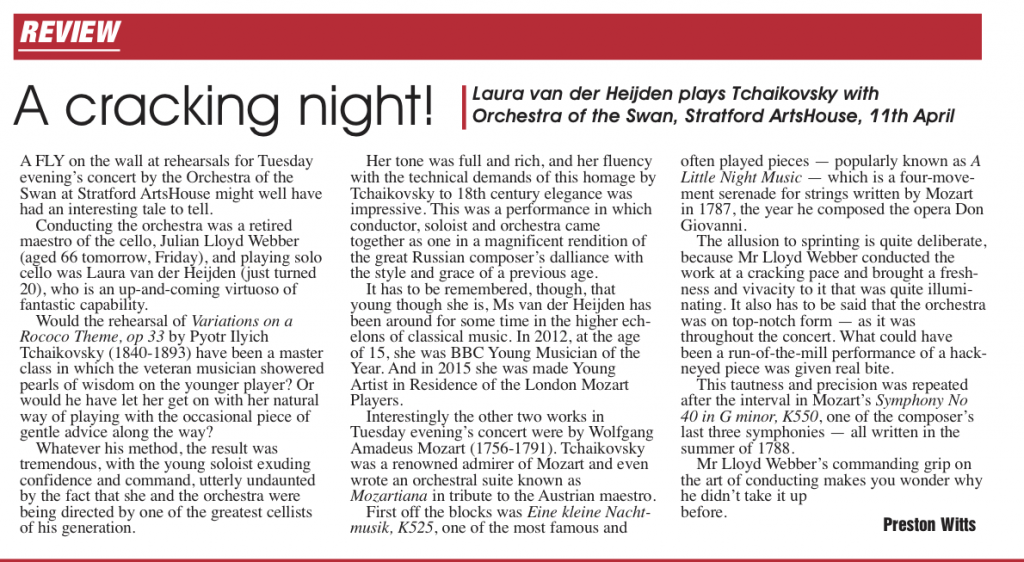
  • Mozart, Eine Kleine Nachtmusik & Symphony no.40

    Birmingham Post, April 20 2017

    Orchestra of the Swan, Birmingham Town Hall

    Full Article by Christpher Morley – click here

    Review, April 2017

    A Cracking Night! by Preston Witts

  • The Art of Julian Lloyd Webber

    Mail on Sunday April 10th 2011

    Julian’s party pieces

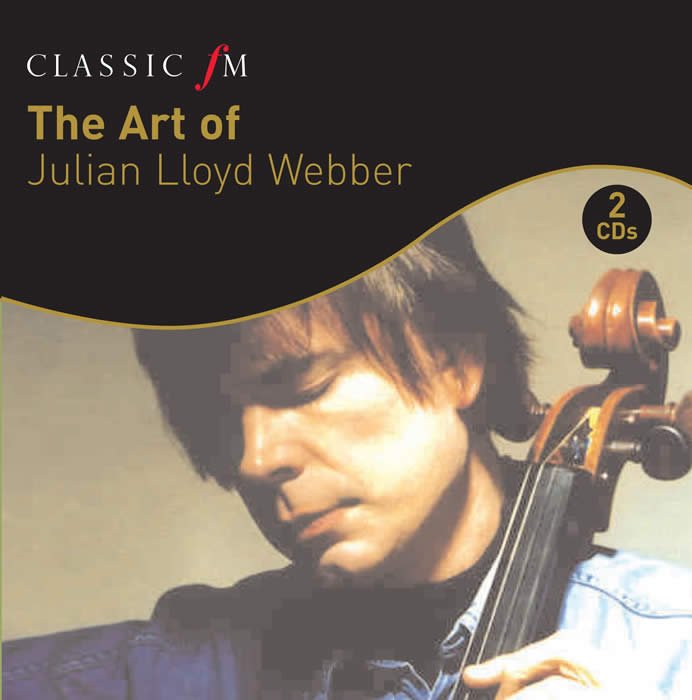
    Many happy returns to one of British music’s finest. Cellist Julian Lloyd Webber celebrates his 60th on Thursday with a birthday concert at the Royal Festival Hall, London, a two-hour special on Classic FM and a two-CD retrospective, The Art Of Julian Lloyd Webber, which includes a charming, newly recorded novelty.

    It’s a rarely heard Arioso for two cellos and strings by Gian Carlo Menotti dating from the Fifties, on which Julian is partnered by his wife, the Chinese cellist Jiaxin Cheng, who is expecting their first child soon.

    But that won’t prevent her playing on Thursday at a gala that also features Julian in Elgar’s concerto, of which he is, in my view, the foremost living exponent, as well as in a new piece for cello by American choral composer Eric Whitacre, provided he’s actually finished it by then.

    The violinist Tasmin Little, the soprano Danielle de Niese, jazz legend Cleo Laine and brother Andrew complete an all-star line-up, ringmastered by Melvyn Bragg, whose South Bank Show had as its signature tune a lively set of Paganini variations composed by Andrew and played by Julian.

    I shall be presiding over the cutting of the cake at the party afterwards, because Julian has been a dear friend for many years.

    But it’s for more reasons than friendship that I hail him today as a musician of real distinction. His Elgar recording, with Yehudi Menuhin, was chosen as the finest ever version by BBC Music Magazine. His Walton concerto was described by the authoritative Gramophone magazine as ‘beyond any rival’. Julian has also recorded a lot of neglected music, especially English pieces by the likes of Frank Bridge and John Ireland, that would have been forgotten but for him.

    Sadly, neither of them features in the new Universal tribute album, but the 33 items included nevertheless span an extraordinary range, and this is a feast for cello lovers.

    Julian has premiered more than 50 new works for his instrument, including a concerto by Philip Glass, given its first performance in Beijing, and a delightful late masterpiece from Joaquin Rodrigo, Concierto Como Un Divertirnento.

    He is dedicated to live music, which is why he gives so generously of his time to chair the Government’s In Harmony programme, intended to emulate Venezuela’s El Sistema in giving underprivileged youngsters a chance to learn an instrument. Julian has never followed fashion, which is why he has played so much neglected music – and also accounts for his lifelong devotion to Leyton Orient.

    David Mellor

  • Walton Passacaglia

    Fanfare June 1997

    BRITISH CELLO MUSIC, Volume I & II

    Julian Lloyd Webber’s performances of British music always carry the imprimatur of authority. and transmit a palpable sense of conviction that never fails to win new devotees to this area of the cello literature. I am especially happy, then, to welcome these splendid offerings back to the catalogs. Lloyd Webber is an artist of missionary enterprise, and his playing is underpinned by a technical assurance that vouchsafes his preeminence as the foremost living exponent of England’s cellistic oeuvre. As a result of his advocacy, works like those collected on these two ASV issues arc increasingly seen as being emblematic of a unique nationalistic subgenre. That these two CDs embrace between them no fewer than six world-premiere recordings bespeaks as much. But that the music is played with such understanding, affection, and profundity of utterance outstrips regular expectations.

    Britten’s Third Suite dates from the spring of 1971, and was premiered by Rostropovich (for whom the previous two Suites and the Cello Symphony were also written) in December 1974. The present performance, which dates from August 1979, is of special import, since it was in fact the first commercial recording of the piece, and it still holds its own in an increasingly competitive field. Julian Lloyd Webber’s account has both the pliant elasticity and the requisite expressive insights to make the most of its frisson and fantasy, but there is a deeper, darker, more elegiac core to this music. Britten’s implementation of the Kontakion, the Russian Orthodox hymn for the departed, is well documented, as is his decision to include an alternative version from English liturgy, and Julian Lloyd Webber plays the English Hymnal interpolation here. The Thema “Sacher,” an intriguing, unaccompanied cryptogram on the letters S-A-C-H-E-R, honored the conductor on the occasion of his seventieth birthday in 1976. A slight sixty-two seconds in duration, the current performance evidences Britten’s ingenuity in the genre, and the playing is magical. Alan Rawsthome’s cello sonata of 1949 (pithy, driven, sometimes truculent, but never crass), makes clever use of recurrent, cyclic themes as earlier motifs are revisited in the Finale: at the time of writing, no other recording exists, so a reading of this quality is the more welcome for its reappearance. The pianist here. and in the remaining accompanied works discussed here (in fact, there is only one other in the case of the first of these two discs, and that is a beguilingly enraptured account of John Ireland’s The Holy Boy) is the pianist and composer John McCabe, with whom Julian Lloyd Webber has enjoyed an especially fruitful collaboration.

    The remaining solo works here are by Sir Malcolm Arnold and Sir William Walton. The former’s 1987 Fantasy for solo cello is, in my view, a splendid addition to the repertoire. Cast in seven highly contrasted movements, its sophistication lurks behind an inscrutability that Hugo Cole describes as “Chinese economy of means.” It is an apt description, and Lloyd Webber’s account (still the only one in the catalog) focuses skillfully on the composer’s desire to draw out the naturalistic, rather than virtuosic, side of the instrument’s persona. The Walton Passacaglia is built along traditional lines (eight-measure theme and ten variations); it condenses Altonian severity and acerbity down to a solitary instrumental voice, and does so masterfully. This performance is mesmeric.

    The second release is devoted to fine readings from both artists of sonatas by Sir Charles Villiers Standford and John Ireland, and two characteristic miniatures by Frank Bridge. The Sonata in G Minor by John Ireland (1923) has been examined in these pages in context of the Marco Polo disc from Raphael Wallfisch and John York (Marco Polo 8.223718). Much as 1 found a lot to admire here (the program is a valuable one, also including the Edmund Rubbra sonata in G Minor, op. 60, and the superb A-Minor Sonata by E. J. Moeran). there remains, on comparison with this ASV version, a degree of blandness and discernible reluctance at times to probe much beyond the outer veneer of the notes. Hence, Julian Lloyd Webber’s playing has instantly more appeal and commu- nicative depth, and John McCabe’s management of the taxing piano part is a model of restraint? perhaps it takes a composer well versed in the ways of both instruments to make this music really work texturally? Of the Bridge pairing, Lloyd Webber relates in his insert note his happenstance discovery of the Scherzetto in a collection of manuscripts at the Royal College of Music, London. He gave the modern premiere of the piece, seventy-seven years after its composition, in April 1976; this slight but delicious encore piece is an ideal foil to the somber mood of the preceding Elegy, dating from 1905. Both performances arc admirable. The other large-scale work is the majestic and uncommonly Brahmsian Second Sonata (op. 93?1893) by Stanford. This work, as deserving of a niche in the repertoire as the similarly neglected Elegiac Variations by Sir Donald Francis Tovey (played quite decently by Rebecca Rust and David Aptcr on Marco Polo 8.223637), receives a robust and impassioned performance here. and. like several of the works contained on these ASV issues, is otherwise unavailable. To sum up. Julian Lloyd Webber’s striking and compelling performances arc of consistent excellence, and recorded sound is likewise entirely serviceable. My only gripe is that the labels with which he is associated, ASV and Philips, have yet to recognize both the musical significance and commercial viability of this area of the cello literature. If they were to relent, however, they would find no better artist for the task than Julian Lloyd Webber, whose performances may be unreservedly commended.

    Michael Jameson

  • Walton Cello Concerto

    Classic FM Magazine September 1997

    It took an altogether more volcanic temperament of English music than Finzi’s to engender Britten’s darkly tremendous Cello Symphony (Philips 454 442-2). Julian Lloyd Webber’s fabulous performance is one of the few I’ve heard that’s at all comparable to that of Rostropovich, for whose transcendent expertise and power the work was written. Lloyd Webber is just as convincing in the wry and romantically sun-dappled sound-world of Walton’s Cello Concerto. Fine accompaniments and ultra-clear recordings set the seal on an exceptional disc.

    Malcolm Hayes

  • Walton Cello Concerto

    Daily Mail 8th August 1997

    Julian scores a rare treat

    BRITTEN CELLO SYMPHONY & WALTON CELLO CONCERTO: Julian Lloyd Webber, (Philips)

    IF ANYONE is going to make Benjamin Britten’s Cello Symphony and William Walton’s Cello Concerto popular, it is Julian Lloyd Webber.

    Both are late works by their composers and both have suffered from neglect – in the Britten’s case, because of a certain air of East Anglian bleakness. The Walton, on the other hand, has always been considered a sort of poor relation of the much earlier Viola Concerto and Violin concerto.

    Lloyd Webber’s new disc is beautifully recorded and he is sympathetically accompanied by Sir Neville Marriner with the St Martin Academy. JLW would be the first to admit that he cannot match the oversized personality of his hero Rostropovich, for whom the Britten work was written. But in his own more restrained, classical fashion, he comes even closer in some ways to the quiet kind of Englishness represented by Britten.

    The Walton is beautifully played by both cellist and orchestra and goes straight to the top of the all-too-few recommendations for this work.

    Even more than some of the foreigners who have played the concerto, JLW and Sir Neville bring out the Mediterranean quality of Walton’s scoring. *****

    Tully Potter

  • Walton Cello Concerto

    Classic CD Choice August 1997

    BRITTEN Cello Symphony, Op. 68 (1963)

    Julian Lloyd Webber (cello); Academy of St Martin in the Fields/Sir Neville Marriner. Philips 454 442-2

    *****

    ‘Exceptional performances by Julian Lloyd Webber, particularly of the Britten’

    Britten’s Cello Symphony was completed soon after his War Requiem, whose dark sound-world and mood of embattled radiance it shares. It’s a massive challenge to its soloist – technically, of course, but even more so in terms of sustaining such a huge musical trajectory.

    It helps if you’re Rostropovich, for whom the Symphony was written. He’d asked Britten for a brilliant concerto, and instead got something rather different: a four-movement work integrating a solo cello and orchestra in nearly unprecedented style. Nearly, but not quite, for Berg’s Violin Concerto takes a similar approach. Britten admired Berg, with whom he’d once hoped to study, and the Cello Symphony responds to the remarkable example of Berg’s work (a Violin Symphony in all but name).

    Rostropovich apart, Julian Lloyd Webber remains one of the few players around who are truly on terms with the Cello Symphony’s extreme demands. As ever, the sound he makes here is not in itself huge, but its production is wonderfully true, accurate, and gloss-free, so that the notes really speak for themselves. The result, combined with a fine orchestral contribution, is a listening experience that’s powerfully moving. For good measure there’s also Walton’s Concerto, in its own way as true to its composer’s mastery as the Symphony is to Britten’s. Lloyd Webber deftly catches its shadowed-sunlight mood, although not even he can get its stop-go finale quite to hang together. The recordings, though better suited to the cool climate of Britten’s East Anglia than the warmth of Walton’s Italy, are strikingly clear and vivid.

    Malcolm Hayes

  • Walton Cello Concerto

    Gramophone August 1997

    Britten Cello Symphony/Walton Cello Concerto

    EDITOR’S CHOICE

    Philips

    Britten Symphony for Cello and Orchestra, Op.68.

    Walton Concerto for Cello and Orchestra.

    Julian Lloyd Webber (vc); Academy of St Martin in the Fields / Sir Neville Marriner.

    Philips CD 454 442-2PH (71 minutes: DDD).

    Britten – selected comparisons:

    Wallfisch, ECO, Bedford (1/86) (CHAN) CHAN8363 Rostropovich. ECO, Britten (9/89) (LOND) 425 100-2LM Isserlis, CLS, Hickox (2/92) (EMI) CDM7 63909-2

    Rostropovich, Moscow PO. Britten (5/97) (EMI) CZS5 72016-2

    Walton – selected comparisons:

    Wallfisch, LPO. Thomson (9/91) (CHAN) CHAN8959 HarreI!, CBSO, Rattle (12/92) (EMI) CDC7 54572-2

    Cohen, Bournemouth SO, Litton (10/95) (LOND) 443 450-2LH

    A British pair

    This is an inspired coupling of two works, closely parallel in the careers of their composers, each reflecting the mastery of a great Russian cellist (respectively Rostropovich and Piatigorsky), but which could hardly be more sharply contrasted. Julian Lloyd Webber in an illuminating note makes that very point, and the passionate commitment of his playing in both works confirms his views. Not only is the power of each piece fully laid out, the beauty – not just in the lusciously romantic Walton Concerto, but in the grittily taxing Britten piece too – is presented as never before on disc, helped by sumptuous, beautifully balanced sound from the Philips team of Dutch engineers. On any count this is the finest, most formidable disc that Julian Lloyd Webber has yet given us.

    Anyone wanting this unique coupling need not hesitate, but my intensive comparisons confirm that both performances are more than competitive with the outstanding versions I have listed above, all with different couplings. In the Britten it almost goes without saying that, like his rivals, Lloyd Webber cannot quite command the power and thrust of the dedicatee, Rostropovich, not just in his original studio recording with Britten and the ECO, but in the Russian radio recording of the world premiere in 1964, which has just appeared as part ofa 13-disc EMI set, “The Russian Recordings, 1950-74”.

    That said, Lloyd Webber and Sir Neville Marriner, helped by the far greater dynamic range of the recording, not only convey the extraordinary originality of Britten’s scoring in a way beyond any rival, but find an extra expressive warmth. That is so not just in such reflective moments of the long sonata-form first movement as the tranquillo passage at track 1, 2’30” or the pianissimo lusingando at 4’50”, but in the relentless build-up of the Adagio third movement, where the recording superbly brings out the rasp of the brass, including tuba. It is worth noting, too, that Lloyd Webber takes the mercurial second movement even faster than the others, with an even lighter touch. On the Wallfisch version I was disappointed that the soloist is placed so far forward that orchestral detail is masked, and that the EMI sound for the Isserlis is relatively dim.

    Wallfisch’s Walton issue from Chandos, by contrast, is the keenest rival to the new disc both in terms of sound and interpretation, and hearing it again reminds me that he studied it with its dedicatee, Piatigorsky. Yet Lloyd Webber is just as individual and imaginative in his phrasing they both outshine the others, for example, in the deeply meditative statement of the theme in the variation finale – and the sumptuousness of the Philips sound makes this if anything even warmer than the Chandos, while the sparky complexity of the central Scherzo is thrillingly clear and trans¬parent. This is a performance which fully confirms this post-war work as vintage Walton, the equal of his pre-war concerto masterpieces for viola and violin. In both the Walton and the Britten Lloyd Webber makes light of the formidable technical difficulties. Plainly this has been a project that has involved him deeply, and he has been wonderfully well served by his collaborators.

    EG

  • Walton Cello Concerto

    Mail on Sunday 13th July 1997

    Walton Cello Concerto/Britten Cello Symphony Julian Lloyd Webber

    Phlhps 454442-2 ****

    Julian Lloyd Webber has joined forces with conductor Sir Neville Marriner to produce this moving new recording of two great cello works. For the Britten, Lloyd Webber makes his cello hum with questing intensity and dark-hued rumblings. He imbues the work with a warped sweetness and a rugged grandeur which brings out the work’s rather Russian feel (it was, after all, written for Rostropovich). Marriner dictates a slow, inexorable tread – the sad, plangent melodies are deliberately trampled underfoot Even the sense of calm in the last movement here seems illusory – a submission, not a resolution. In the Walton too, there is a haunting, unsettling quality to the performance. A disc to test your emotions and your nerve.

    James Inverne